Choosing a reinforced silicone hose involves more than matching dimensions. The wrong construction may expand under pressure, collapse under vacuum, or deteriorate when exposed to excessive heat. For buyers, understanding the differences between reinforcement materials is essential to selecting a hose that fits the operating environment.
This guide compares common constructions, explains their automotive and industrial applications, and outlines the key factors to check before purchasing.
Key Takeaways
-
Polyester braiding improves pressure handling while retaining hose flexibility.
-
Fiberglass and aramid reinforcement are suitable for high-temperature demanding environments.
-
Wire reinforcement prevents hose collapse under vacuum service.
-
Platinum curing is a silicone curing process, not a type of reinforcement material.
What Is a Reinforced Silicone Hose?
A reinforced silicone hose combines a silicone rubber body with one or more reinforcement layers. Silicone provides flexibility and temperature resistance, while the reinforcement helps the hose withstand mechanical demands and maintain its shape.
Performance depends on the silicone formulation, reinforcement material, layer arrangement, wall thickness, and manufacturing quality. The reinforcement type alone does not establish a hose’s pressure rating or temperature limit.
For purchasing teams, comparing application requirements and documented specifications is more reliable than assuming that hoses with similar appearances offer equivalent performance.
Types of Reinforced Silicone Hose and Their Materials
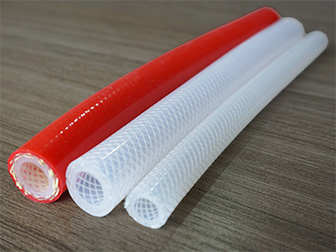
Polyester Braid Reinforced Silicone Hose
A braid reinforced silicone hose uses woven polyester yarn within the silicone wall. The braid helps improve pressure-handling capability while retaining flexibility, making this construction suitable for applications such as coolant circulation, heater connections, and other automotive fluid or air-routing systems.
Typical operating temperature range for this style is -50°C to +200°C. This range applies to specific product lines and should not be treated as a universal rating for all polyester-braided hoses. Buyers should confirm required working pressure, media compatibility and service constraints before selection.
When evaluating this construction, the number of braid layers describes the design layout, but it cannot replace product-specific performance test data.
Fiberglass-Reinforced Silicone Hose
Fiberglass reinforcement is used in silicone hose constructions designed for demanding thermal environments. It may be appropriate when standard fabric reinforcement cannot meet the application’s temperature requirements.
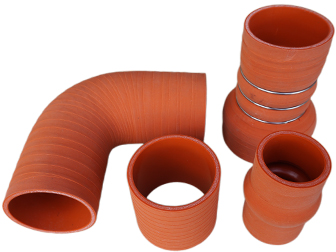
This style is commonly available in four- and five-ply constructions, with a listed temperature range of -55°C to +280°C. Straight, transition, and hump configurations are offered. These specifications apply to the corresponding product range; suitability must always be verified against actual operating conditions.
For high-temperature systems, check continuous operating temperature and short-term peak temperature. Nearby heat sources, airflow, contact with surrounding components, and pressure fluctuations will also affect service life.
Aramid-Reinforced Silicone Hose
Aramid reinforcement, including Kevlar-type fiber constructions, is another option for demanding applications with elevated temperatures and boost pressure. This four- or five-ply hose is rated from -65°F (-54°C) to 510°F (266°C). These figures apply to the specified product, not all aramid-reinforced silicone hoses.
When comparing aramid and fiberglass options, review the rated temperature, pressure requirements, dimensions, and product documentation, rather than selecting based only on the fiber type.
Wire Reinforced Silicone Hose
A
wire reinforced silicone hose incorporates meta
l wire into the silicone structure, primarily for vacuum applications where suction may cause an unsupported hose to flatten or collapse. Common wire materials include spring steel and stainless steel.
Wire reinforcement supports the hose wall to preserve flow geometry under suction. Final suitability depends on the required vacuum level, bend radius, hose construction, wire material and installation limits. Vacuum-rated performance does not guarantee compatibility with all positive-pressure applications.
Platinum-Cured Reinforced Silicone Hose
A platinum cured reinforced silicone hose combines reinforcement layers with silicone cured via a platinum-based curing system. Platinum curing refers to the manufacturing process, not a separate reinforcement material. The hose may still adopt braided reinforcement, so curing method and reinforcement structure need to be assessed independently.
This reinforced braided silicone tubing is developed for food-contact use. Relevant compliance references include FDA 21 CFR 177.2600, RoHS, REACH, and EU Regulation 1935/2004. Buyers must verify test certificates and declarations for the exact product and intended use, as platinum curing alone does not automatically satisfy regulatory requirements.
Disclaimer: The specifications and compliance references in this section are based on SUNRISE product data.
Advantages in Automotive and Industrial Applications
Reinforcement handles mechanical loads that unreinforced silicone tubing cannot withstand reliably. Within automotive systems, reinforced structures boost pressure resistance, preserve hose shape, and enable routing inside compact engine bays.
Different constructions serve different purposes:
Coolant and heater systems: Braided reinforcement meets pressure demands while keeping good flexibility.
Turbocharger and charge-air systems: Multi-ply or specialty fiber-reinforced hoses are recommended for high-temperature, boost-pressure conditions.
Vacuum connections: Embedded wire resists collapse under suction.
Food-processing equipment: Platinum-cured reinforced tubing balances flexibility, mechanical strength and food-contact compliance.
Industrial equipment: The correct construction is determined by temperature, pressure or vacuum rating, conveyed media and installation constraints.
Important note: Adding reinforcement does not make silicone compatible with all fuels, oils or aggressive chemicals. For such media, verify compatibility with the inner liner and full hose assembly; specialized barrier liners are often required.
How to Choose the Right Reinforced Silicone Hose
A practical selection process starts with real operating conditions.
-
Define pressure or vacuum requirements. Establish normal operating levels, transient surge conditions, and the risk of collapse under suction. Confirm the selected hose is rated for the intended service.
-
Check temperature exposure. Match continuous operating temperature and peak temperature against the product rating. Account for heat radiated from adjacent components, not only the temperature of the conveyed fluid.
-
Verify media compatibility. Silicone is not compatible with all fluids. Cross-check the inner material against coolant, oil, chemical, gas or food-contact requirements. Some applications require a custom barrier liner.
-
Evaluate fit and routing. Confirm inside diameter, outside diameter, wall thickness, bend radius, connection dimensions and available clearance. Even material-compliant hoses may fail if they kink or interfere with surrounding parts.
-
Review documentation. Collect dimensional drawings, performance specs, applicable standards, test reports and compliance certificates. General material descriptions cannot replace validation for your selected part number.
SUNRISE manufactures
reinforced silicone hose options for automotive, industrial, vacuum, and food-related applications. Matching operating conditions against published product specifications helps buyers identify the most suitable construction.
FAQ
How Do You Choose a Reinforced Silicone Hose for High-Temperature Applications?
Start with continuous operating temperature and short-term peak temperature, then review the full hose construction and its official rating. Fiberglass and aramid reinforced hoses work for severe thermal environments, but the highest temperature rating does not always equal the best fit. Also evaluate working pressure, routing layout, nearby heat sources and conveyed media.
How Do You Cut Reinforced Silicone Hose Without Damaging It?
Use a sharp, suitable cutting tool and firmly secure the hose to prevent shifting during cutting. Aim for a clean, square cut. Inspect the cut end for jagged edges, displaced reinforcement or exposed wire. Wire-reinforced hoses require extra care: bare cut metal edges present safety risks. Follow the handling instructions for that hose style. Discard the cut section if reinforcement or the sealing surface becomes damaged.