Industrial silicone tubing is widely used in industrial equipment, fluid transfer systems, vacuum applications, and protective installations where temperature resistance, flexibility, and long-term material stability are important. Compared with many conventional rubber tubes, silicone tubing offers excellent resistance to temperature fluctuations, UV exposure, ozone, and aging, making it suitable for demanding operating environments.
However, not all industrial silicone tubing is designed for the same purpose. Wall thickness, inner diameter, material formulation, reinforcement, and operating conditions all influence its performance. Understanding these differences helps equipment manufacturers, industrial buyers, and engineers select the right tubing for their applications.
SUNRISE specializes in silicone hose and extruded silicone products, providing industrial silicone tubing in different sizes, colors, and performance specifications to meet customer requirements.
Industrial silicone tubing is a flexible tube manufactured from silicone rubber, commonly through an extrusion process. It is designed to transport air, vacuum, certain liquids, and other compatible materials, or to provide protective insulation for wires and components.
Unlike rigid plastic pipes, silicone tubing maintains flexibility across a broad temperature range. It can also withstand exposure to UV radiation, ozone, and environmental aging, making it useful in industrial installations where conventional materials may deteriorate over time.
For example, SUNRISE manufactures high-temperature silicone tubing with a recommended working temperature range of -65°F to 482°F (-53.9°C to +250°C). The actual operating limits should always be confirmed according to the specific material formulation and application conditions.
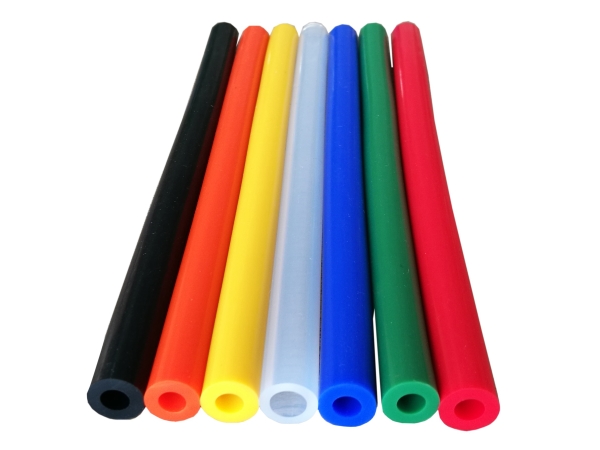
As a manufacturer of extruded silicone products, SUNRISE can customize tubing according to customer drawings, dimensions, colors, and application requirements. Explore the industrial silicone tubing product range for more details.
Industrial silicone tubing can be classified according to its construction, material properties, and intended application. The following types address different operating requirements.
Unreinforced silicone tubing is produced through an extrusion process without additional reinforcing layers. Its simple construction makes it suitable for applications requiring flexibility, consistent dimensions, and convenient installation.
Common applications include air transfer, low-pressure fluid connections, vacuum lines, and protective sleeves. Inner diameter, outer diameter, and wall thickness can be adjusted to match equipment requirements.
High-temperature silicone tubing is formulated for environments involving elevated temperatures and thermal fluctuations. It is commonly selected for industrial equipment, heating systems, and applications where material flexibility needs to be maintained under heat exposure.
Its resistance to UV radiation, ozone, and aging also makes it useful in equipment exposed to outdoor or demanding environmental conditions.
For applications requiring additional chemical resistance, the compatibility between the silicone formulation and the actual working medium should be evaluated before production.
Braided silicone tubing incorporates a reinforcing layer, commonly polyester or other suitable fibers, within its construction. The reinforcement helps improve dimensional stability and pressure-handling capability compared with conventional unreinforced tubing.
It is suitable for selected liquid and air transfer applications where additional mechanical strength is required. Reinforcement material and construction should be selected according to the working pressure, temperature, and bending requirements.
Wire-reinforced silicone tubing contains a metal wire structure within its wall. This construction is particularly useful in vacuum applications where the tubing needs additional resistance to collapse.
It can be considered for equipment connections and vacuum systems that require flexibility while maintaining the tube's shape under negative pressure. The wire structure and tube dimensions should be designed around the actual installation conditions.
The versatility of silicone rubber allows industrial silicone tubing to serve different functions across multiple sectors. The right tubing depends on the transported medium, operating temperature, pressure, and surrounding environment.
In industrial machinery, silicone tubing can be used for air connections, vacuum systems, equipment protection, and selected fluid transfer applications. Its flexibility makes installation easier in confined spaces or equipment with complex internal layouts.
Some industrial silicone tubing formulations offer resistance to selected acids, alkalis, and chemicals. They can be considered for compatible chemical transfer systems and equipment operating in challenging environments.
However, silicone is not universally resistant to every chemical. Chemical concentration, exposure duration, temperature, and material formulation must be evaluated before choosing a tube for chemical handling.
Silicone tubing can also function as an insulating and protective sleeve for wires, cables, and electronic components. Its electrical insulation properties and resistance to environmental aging make it useful in applications where components need additional protection.
For example, silicone sleeves can help protect wiring in equipment exposed to elevated temperatures or harsh environmental conditions.
For food-processing and pharmaceutical equipment, specially formulated food-grade silicone tubing can be used in suitable fluid transfer applications. Material purity, curing process, and applicable food-contact requirements are important considerations.
SUNRISE also supplies food-grade silicone hose and tubing products, including platinum-cured options for applications requiring specific food-contact compliance.
Choosing industrial silicone tubing involves more than checking its nominal diameter. Buyers should evaluate the actual operating environment and technical requirements before confirming a specification.
Check both the minimum and maximum operating temperatures. Continuous exposure to high temperatures may affect material properties differently from short-term temperature peaks. Always confirm the recommended working range for the selected silicone compound.
Tube dimensions directly affect installation compatibility, flow capacity, flexibility, and mechanical performance. Provide accurate measurements and dimensional tolerances when requesting a custom product.
If the tubing will contact chemicals, oils, solvents, or other industrial media, confirm compatibility with the actual substance and operating conditions. Standard silicone tubing should not automatically be considered suitable for fuel or oil transfer.
Determine whether the tubing will operate under positive pressure, negative pressure, or atmospheric conditions. Reinforced constructions may be more appropriate when additional pressure resistance or vacuum stability is required.
Consider whether the tubing will be exposed to sunlight, ozone, moisture, dust, vibration, or repeated bending. These factors help determine the appropriate silicone formulation and construction.
Standard tubing dimensions and colors do not always meet the requirements of specialized equipment. Custom manufacturing allows buyers to specify product details according to their installation and performance needs.
SUNRISE provides custom silicone tubing manufactured through mechanical extrusion. Available customization options include:
For projects involving non-standard dimensions or special performance requirements, SUNRISE can provide technical references during product development. Visit the custom silicone tubing page to learn more about available customization options.
Choosing a suitable silicone tubing manufacturer is important for maintaining product consistency and meeting application-specific requirements.
SUNRISE Silicone Hose Co., Limited has been manufacturing silicone hoses and silicone molded products since 2006. The company holds ISO 9001 and IATF 16949 certifications and supplies products for automotive, railway, marine, industrial machinery, electronics, healthcare, and other applications.
For industrial silicone tubing projects, SUNRISE offers:
Whether you need standard industrial silicone tubing or a customized extruded solution, providing detailed technical requirements helps the manufacturer recommend a suitable product specification.
Industrial silicone tubing is used for compatible air and fluid transfer, vacuum connections, equipment insulation, and protective sleeves. Typical applications include industrial machinery, electronic equipment, chemical processing systems, and specialized equipment.
The temperature range depends on the silicone formulation and product construction. SUNRISE lists a recommended working temperature range of -65°F to 482°F (-53.9°C to +250°C) for its custom silicone tubing. Buyers should confirm the operating limits for their specific application.
Some silicone tubing formulations offer resistance to selected acids and alkalis. However, chemical compatibility varies depending on the chemical type, concentration, temperature, and exposure time. Testing or technical confirmation is recommended before use.
Yes. SUNRISE can customize silicone tubing according to customer requirements, including inner diameter, outer diameter, wall thickness, length, color, and logo placement. Special performance requirements can also be discussed during product development.
Extruded silicone tubing is generally a single-layer construction without reinforcement, making it suitable for flexible, low-pressure applications. Braided silicone tubing incorporates reinforcing fibers to improve dimensional stability and pressure-handling capability.
Prepare the required inner diameter, outer diameter, wall thickness, length, color, operating temperature, working medium, and pressure conditions. Drawings or physical samples can also help the manufacturer evaluate the design and provide a more accurate quotation.
If you are looking for a reliable solution for your industrial equipment or production system, contact SUNRISE to discuss your silicone tubing requirements.

Sunrise Silicone Hose Co., Limited


Address : Suite 805, No. 341 Jiahe Road, Xiamen City, Fujian Province, China
Email : sales@siliconehose-china.com