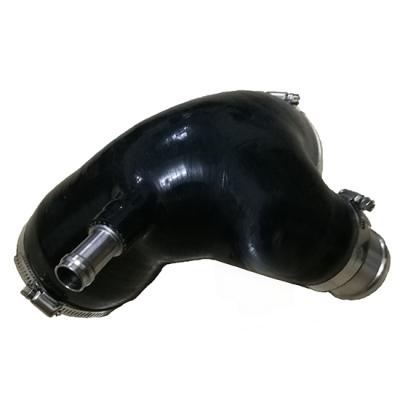
A custom silicone hose is rarely just a standard tube with different dimensions. In many industrial and automotive applications, the hose must follow a specific routing path, fit limited installation space, connect different components, or withstand particular operating conditions. This is why manufacturers often need a hose developed from an engineering drawing, an existing component, or even a handmade prototype.
For buyers sourcing custom silicone hoses, the manufacturing process starts long before production. Dimensions, material selection, reinforcement, hose geometry, and application requirements all need to be reviewed before a suitable product can be made.
Before requesting a quotation, buyers should prepare as much technical information as possible. Complete specifications help manufacturers evaluate the hose construction, identify potential production challenges, and recommend a suitable manufacturing method.
A technical drawing is one of the most useful references for custom silicone hose production. It helps define the hose geometry and provides measurable requirements for manufacturing and inspection.
Depending on the complexity of the hose, SUNRISE accepts different design references:
Important dimensions may include inner diameter (ID), outer diameter (OD), wall thickness, overall length, leg length, bend angle, and connection dimensions. For multi-branch or irregularly shaped hoses, additional dimensional details are particularly important.
Not every buyer has access to a complete engineering drawing. In some projects, the original hose is already installed in a machine or vehicle, and the purchasing team only has an existing component available for reference.
In these situations, a physical sample can be used as the starting point for custom development. SUNRISE can duplicate hoses based on customer-provided samples, including used hoses and handmade prototypes.
When submitting a sample, it is helpful to provide additional information about its application, connection points, material requirements, and operating environment. If the original hose has become deformed, damaged, or aged, measurements and application details can help clarify its intended original geometry.

Once the design reference has been reviewed, the next step is to determine the appropriate material and hose construction. Silicone hoses are available in different formulations and reinforcement structures. The right combination depends on the actual operating conditions rather than appearance alone.
Buyers should explain what the hose will convey and the environment in which it will operate. Relevant considerations include working temperature, pressure or vacuum conditions, fluid contact, exposure to oil or fuel, and applicable industry requirements.
For example, different applications may require different material solutions:
For applications involving fuel or oil, standard silicone should not automatically be treated as suitable. A compatible lining or alternative material may be necessary. SUNRISE also manufactures custom silicone turbo hoses and special-purpose lined hose solutions for different application requirements.
Reinforcement affects the mechanical behavior, flexibility, and pressure-handling characteristics of a silicone hose. The required construction should be selected according to the application and validated against its operating conditions.
Common reinforcement options offered by SUNRISE include:
Wall thickness, reinforcement layers, and hose diameter should be considered together. Increasing reinforcement alone does not guarantee that a hose will meet a particular pressure or vacuum requirement. The complete construction must be evaluated for the intended service conditions.

A successful custom hose project requires communication between the buyer and manufacturer at several stages. The exact workflow depends on the hose design, tooling requirements, and order specifications, but the following steps provide a practical overview.
After receiving a drawing, sample, or specification, the manufacturer reviews the proposed hose structure. This includes checking dimensions, bend configurations, reinforcement requirements, connection details, and material compatibility.
If important information is missing, the manufacturer may need clarification before confirming the production approach. For example, a hose intended for a high-vacuum application should not be evaluated in the same way as a simple coolant connection.
The selected manufacturing method depends on the hose geometry and construction. Straight and relatively simple hose designs may be handled differently from multi-bend or complex molded configurations.
For molded silicone hoses, tooling and forming arrangements need to match the intended shape. Complex configurations may require dedicated mandrels or other production preparations. The purpose is to reproduce the required geometry while maintaining the specified dimensions and construction.
Buyers developing complex assemblies can also review custom molded silicone hose solutions for radiator and heater hose applications.
Before moving into a larger production order, sample evaluation helps confirm whether the proposed hose matches the required design.
Depending on the project, buyers should review:
Any dimensional or functional differences should be discussed before the production specification is finalized. This stage is especially important for replacement hoses and components used in assemblies with limited installation space.
After the sample and technical requirements have been approved, the project can proceed to batch production. Inspection requirements should be agreed upon in advance so that the finished products can be evaluated against the approved specifications.
For repeat orders, retaining the approved drawing, material information, sample reference, and inspection requirements helps maintain consistency between production batches.
Custom silicone hose manufacturing covers more than straight tubing. Different industries require different shapes, reinforcement structures, and connection configurations. SUNRISE provides several types of silicone hose products to support these applications.
Automotive applications commonly use silicone hoses in cooling, air intake, turbocharger, and charge air systems. Depending on the installation requirements, hoses may feature straight sections, reducers, elbows, multiple bends, or reinforced constructions.
For these projects, buyers can explore silicone coolant hoses and custom radiator hose solutions. The final material and reinforcement should be selected according to the coolant type, temperature range, and applicable vehicle specifications.
Industrial equipment may require hoses with specific routing paths, connection structures, or resistance to vacuum conditions. Where hose collapse is a concern, wire reinforcement can be considered as part of the design.
SUNRISE offers wire reinforced silicone hoses for applications requiring additional structural support under vacuum conditions.
Food processing equipment, beverage systems, and fluid transfer applications may require silicone hoses with appropriate food-contact properties. Material selection and curing methods should be confirmed according to the intended contact conditions and applicable regulations.
For these projects, buyers should specify the conveyed substance, cleaning conditions, temperature, and required compliance documents before selecting a suitable hose construction.
There is no single standard price for every custom silicone hose. The quotation depends on the design, materials, production method, tooling requirements, and order quantity.
The main factors include:
According to SUNRISE's product information, the general minimum order quantity for silicone hoses is 10 pieces per item, and first-article validation is acceptable. However, MOQ may vary by product and construction, so buyers should confirm the actual requirement when requesting a quotation.
Providing complete drawings and application details at the beginning can help reduce unnecessary clarification and make the quotation process more efficient.
Choosing a custom silicone hose manufacturer involves more than comparing unit prices. Buyers also need to understand whether the supplier can review technical requirements, handle different hose constructions, and communicate effectively throughout product development.
SUNRISE SILICONE HOSE CO., LIMITED has been manufacturing performance silicone hoses and molded silicone products since 2006. The company holds ISO 9001 and IATF 16949 certifications and supplies products for automotive, railway, industrial equipment, healthcare equipment, and other applications.
Its custom manufacturing capabilities include:
For buyers who need branded components, custom silicone hose logo printing and marking can also be discussed during the development stage.
If you are planning a custom silicone hose project, preparing the right information can help the manufacturer understand your requirements more accurately.
Before contacting SUNRISE, consider preparing the following:
If you do not have a complete drawing, you can still start with an existing hose sample or a dimensional sketch. SUNRISE can review the available reference information and discuss the next steps for custom development.
To discuss your project, visit the SUNRISE contact page or email sales@siliconehose-china.com with your drawings, samples, and application requirements.
Yes. SUNRISE manufactures custom silicone hoses based on customer specifications, sketches, 2D drawings, and 3D CAD files. For complex designs, IGES (.igs) and STEP (.stp) formats are accepted.
Yes. SUNRISE can duplicate silicone hoses based on customer-provided physical samples, including used hoses and handmade prototypes. Providing application details and dimensional information can help with design evaluation.
The general MOQ listed by SUNRISE for silicone hoses is 10 pieces per item, and first-article validation is acceptable. The actual MOQ should be confirmed for the specific product and construction.
Useful information includes the drawing or sample, inner and outer diameters, wall thickness, hose length, bend configuration, material, reinforcement, operating temperature, pressure or vacuum conditions, and application details.
Yes. SUNRISE offers polyester, aramid, fiberglass, and steel wire reinforced silicone hose constructions, as well as custom-shaped hoses. The appropriate design depends on the installation and operating requirements.
Yes. SUNRISE manufactures silicone hoses with aluminum or stainless-steel connection components and supports customer logo printing and part marking according to project requirements.

Sunrise Silicone Hose Co., Limited


Address : Suite 805, No. 341 Jiahe Road, Xiamen City, Fujian Province, China
Email : sales@siliconehose-china.com