When a hose route needs to change direction between two connection points, a pre-formed silicone elbow can provide the required turn. Choosing between a 45° and a 90° design, however, involves more than checking the nominal angle. Connection orientation, spacing, bend radius, and available clearance all affect whether the elbow will fit without unnecessary installation stress.
The practical rule is to select the angle that matches the required change in hose direction, then verify the dimensions and operating requirements. Neither configuration is universally more compact, more efficient, or better suited to every application.
This guide compares both elbow types and explains what engineers and OEM buyers should check before selecting a standard or custom connection.
Key Takeaways
-
A 45° elbow provides a 45-degree change in direction, while a 90° elbow creates a right-angle turn.
-
Connection-axis orientation and spacing must be checked together; positional offset alone does not determine the correct angle.
-
Bend angle and bend radius are separate dimensions that influence fitment and internal geometry.
-
Material compatibility, reinforcement, temperature, pressure, and vacuum requirements must be evaluated independently of angle.
What Is a 45 Degree Silicone Elbow?
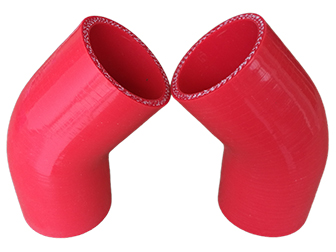
A 45 degree silicone elbow is a pre-formed hose connector that changes the hose direction by 45 degrees. It provides an angled connection without requiring a straight hose to be forced into a bend.
This configuration is suitable when the required route includes an approximately 45-degree directional change and the elbow’s dimensions match the connection spacing. It can be useful in coolant plumbing where the hose needs to follow an angled path around nearby components.
However, two ports being diagonally positioned does not automatically mean a 45° elbow will fit. Their axis directions, separation, and insertion requirements must also match the proposed connection.
When Is a 45° Elbow Useful?
Consider a 45° silicone elbow when:
-
The required hose route includes a 45-degree change in direction.
-
A straight coupler does not match the orientation of the mating pipes.
-
The available layout accommodates the elbow’s bend radius and leg lengths.
-
An angled transition suits the assembly better than a right-angle route.
The benefit is a suitable connection geometry, not an automatic improvement in pressure capability, installation space, or flow performance.
What Is a 90 Degree Silicone Elbow?
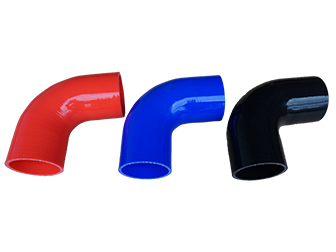
A 90 degree silicone elbow is a pre-formed connector that changes the hose direction by 90 degrees. It is commonly considered when the intended route turns between perpendicular directions.
For example, it may connect a horizontal coolant pipe to a vertically oriented connection, provided the spacing, bend position, and end dimensions are compatible.
A pre-formed right-angle hose establishes the required turn without relying on a straight hose to bend sharply. It still needs adequate clearance around the outside of the bend and sufficient straight length at each end for fitting engagement and clamping.
When Is a 90° Elbow Useful?
Consider a 90° silicone elbow when:
-
The hose route requires a right-angle change in direction.
-
The mating connection axes and spacing suit a single 90-degree bend.
-
There is sufficient clearance for the elbow’s actual installation envelope.
-
A defined right-angle connection avoids an unsuitable improvised route.
Do not rely on twisting or forcing the elbow to compensate for a significant mismatch in connection orientation.
Common Applications of Silicone Elbows
45° and 90° silicone elbows are used where a cooling or air-handling line needs a defined change in direction. Common applications include:
-
Cooling and heater circuits: Connections between coolant pipes, radiator connections, and heater lines where the route must accommodate surrounding components.
-
Air-intake systems: Angled connections around air filters and engine intake components, with the construction assessed for any suction conditions.
-
Turbocharger and intercooler piping: Flexible connections in charge-air routes, where the hose must meet the specified pressure, temperature, and media-exposure requirements.
-
Modified vehicles and equipment: Custom routing where changes in component position make a standard straight connection unsuitable.
These applications may use either angle. The choice depends on the connection-axis orientation, spacing, bend radius, and available clearance, not simply the type of vehicle or system. Suitability for one application should not be assumed to establish suitability for another.
90 Degree vs 45 Degree Silicone Elbows: Key Differences
The main difference is the amount of directional change. Other characteristics depend on the individual product dimensions and construction.
Comparison
|
45° Silicone Elbow
|
90° Silicone Elbow
|
Direction change
|
A nominal 45° change in direction
|
A nominal 90° right-angle turn
|
Typical routing
|
Routes requiring a 45° change in direction
|
Routes requiring a right-angle change in direction
|
Installation layout
|
May require additional components if the complete route needs a larger directional change
|
Can provide a single-elbow connection for a 90° turn when the connection orientation and spacing match
|
Space requirements
|
Depends on bend radius, leg lengths, outside diameter, and available clearance
|
Depends on bend radius, leg lengths, outside diameter, and available clearance
|
Fitment checks
|
Confirm connection-axis orientation, spacing, insertion length, and clamp clearance
|
Confirm connection-axis orientation, spacing, insertion length, and clamp clearance
|
Bend angle alone does not determine flexibility, pressure capability, or flow performance. Check the dimensional drawing and specifications of the selected elbow against the complete assembly requirements.
Does Bend Angle Determine Bend Radius?
No. Bend angle describes how much the hose changes direction. Bend radius describes the curvature of that turn. The measurement reference can vary by hose type and manufacturer, so check the supplier’s drawing or specification rather than assuming a particular reference point.
A 45° elbow does not necessarily have a larger bend radius than a 90° elbow. Likewise, two 90° elbows can have different radii and overall dimensions.
This distinction matters because the radius affects both the installation envelope and the internal flow path. Check the dimensional drawing rather than estimating curvature from the nominal angle or a product photograph.
Which Elbow Takes Up Less Space?
Neither design is universally more space-efficient.
A 90° elbow may provide a direct connection where a right-angle turn is required. A 45° elbow may suit an angled route but require additional pipework if the assembly ultimately needs a larger change in direction.
Compare the complete installed route, including:
-
Outside clearance around the bend.
-
Straight lengths needed for insertion and clamps.
-
Adjacent pipes, brackets, and equipment.
-
Space needed to install and access the connection.
-
Expected movement between connected components.
A component that looks smaller in isolation may not produce the most compact complete assembly.
Which Elbow Has Lower Pressure Loss?
Under otherwise comparable conditions, a smaller directional change generally produces less local turning loss. However, actual pressure loss also depends on the inside diameter, bend radius, internal profile, fluid properties, and flow rate.
A single 45° elbow and a single 90° elbow do not perform the same routing task. If a system requires a 90° turn, using 45° components changes the complete arrangement and may introduce additional joints or connecting sections.
For a flow-critical application, compare the complete proposed routes using suitable calculations or pressure-drop data. Do not assume that selecting the smaller angle automatically improves system performance.
How to Choose the Right Silicone Elbow
The correct elbow should match the connection geometry and operating requirements of the complete hose assembly. Use the following steps to evaluate a suitable configuration.
Step 1: Establish the Connection Geometry
Record the position and axis direction of each mating pipe or port. Determine the required change in hose direction, then check whether a standard elbow can bridge the spacing.
A positional offset alone is not enough to select the angle. For example, two offset but parallel connections may need an offset-shaped hose or a multi-component route rather than a single elbow.
If neither standard angle fits, consider a different leg length, a reducing configuration, or a custom-shaped hose.
Step 2: Check the Installation Envelope
Use the elbow’s actual dimensions to review clearance around the intended route. Include the bend radius, outside diameter, leg lengths, and clamp locations.
Also consider movement. A hose that clears a bracket while stationary may contact it when the engine or equipment moves. The route should avoid rubbing, sharp edges, and unnecessary loading of the connection points.
Step 3: Confirm End Dimensions and Clamping Lengths
Specify the required hose inside diameter against the mating fitting dimensions. For reducing elbows, identify both end diameters and their orientation in the assembly.
Check the straight length available at each end for fitting insertion and clamp placement. A clamp should secure a correctly fitted connection, not pull an incorrectly shaped hose into position.
Where space is restricted, confirm that the proposed clamp can be installed, tightened, and inspected.
Step 4: Define the Operating Conditions
The bend angle does not establish the hose’s performance rating. Provide the relevant operating requirements, including:
-
Continuous and peak temperatures.
-
Working pressure and transient pressure conditions.
-
Any vacuum or collapse-resistance requirements.
-
The fluid or gas contacting the inner surface.
-
External heat, abrasion, and environmental exposure.
A temperature limit should apply to the complete hose construction, not just the base silicone material. Similarly, the number of reinforcement layers should not be used as a substitute for an approved pressure or vacuum specification.
Standard silicone should not automatically be selected for fuel or oil transfer. Where these media are present, the compound or lining must be evaluated for the specific exposure.
Step 5: Agree on Sample Acceptance
For custom applications, establish how the proposed elbow will be checked before production approval.
A useful acceptance plan separates:
-
Dimensional conformity to the approved drawing.
-
Fitment in the intended assembly.
-
Required pressure, leakage, vacuum, or other performance tests.
Record the drawing revision and any accepted deviations. This gives the buyer and manufacturer a consistent reference for repeat orders.
SUNRISE Silicone Elbow Options
SUNRISE offers 45 degree silicone elbows and 90
degree silicone elbows with polyester-reinforced silicone constructions for coolant plumbing applications. Both category pages describe multi-layer reinforcement and reference SAE J20 requirements.
The listed options include custom lengths, diameters, and colors. For a custom project, provide the connection geometry and operating conditions together so that the proposed dimensions and construction can be reviewed against the complete assembly.
The category pages do not publish a single temperature range, reinforcement-layer count, or pressure rating covering every configuration. These details should therefore be confirmed in the product specification rather than assumed from the elbow angle.
Frequently Asked Questions
How do I measure a silicone elbow hose correctly?
Measure the inside diameter at each end, the bend angle, bend radius, and overall dimensions. Confirm the supplier’s reference points for leg-length measurements, since dimensions may refer to a bend tangent point or another drawing reference. Also identify the straight length available for fitting insertion and clamping. A dimensioned drawing is the clearest way to avoid ambiguity.
Can two 45° silicone elbows create a 90° turn?
Yes. Two 45° elbows can provide a net 90-degree change in direction when arranged in the same plane and turning in the same direction.
However, this arrangement is not geometrically identical to a single 90° elbow. The spacing, connecting section, additional joints, and available clearance must be checked. It should not automatically be assumed to have lower pressure loss.
Can a silicone elbow connect to a metal or plastic pipe?
Yes, provided the hose, pipe, and retention arrangement are compatible. Check the mating dimensions, insertion length, pipe surface, clamp suitability, and operating conditions. Plastic fittings also need to tolerate the specified clamping load and service temperature.
How can I reduce the risk of leakage after installation?
Insert each hose end to the specified depth. Position and tighten compatible clamps according to the approved assembly requirements.
Check that the mating surfaces are clean and undamaged, and that the hose is not twisted or forced out of alignment. Perform the specified leak check before returning the assembly to service.
What if neither a 45° nor a 90° elbow fits?
Do not force a standard elbow to compensate for a substantial geometry mismatch.
Review the connection positions, axis directions, and available space. A different leg length, reducing elbow, offset hose, or custom-shaped connection may provide a more suitable solution.