Most buyers approach silicone hose selection by asking two questions first: what is the temperature rating, and what is the price? Both matter — but starting there often leads to the wrong product. A silicone hose that meets the temperature specification on paper can still fail prematurely if the reinforcement structure does not match the pressure conditions, if the compound is incompatible with the fluid being transferred, or if the construction was designed for a different type of load entirely.
This article explains how silicone hoses actually work — not just what they are made of, but how their structure responds to different operating conditions. It also addresses four assumptions that commonly lead B2B buyers to specify the wrong product, and offers a practical framework for matching hose type to application.
What Are the Different Types of Silicone Hoses?
Silicone hoses are not a single product category. The term covers a wide range of constructions with meaningfully different structures, working principles, and performance characteristics. Understanding the main categories is the first step toward correct selection.
Vehicle silicone hose is the broadest and most technically demanding category. It includes silicone hose for coolant systems, silicone radiator hose, turbo hose, charge air cooler hose, air intake hose, silicone vacuum hose, heater hose, and fuel cell hose. Each of these serves a different system with different temperature, pressure, fluid, and geometric requirements. A silicone rad hose connecting the radiator to the engine block operates under different conditions from a turbo hose handling pressurized hot air, even though both sit in the same engine compartment.
Special use silicone hose covers constructions engineered for demanding or unusual conditions. Wire-reinforced silicone hose uses a spiral steel structure embedded in the wall to resist collapse under vacuum.
Kevlar and aramid-reinforced hose provides higher burst strength at lower wall thickness. Glassfiber-reinforced hose extends useful temperature range closer to heat sources. Fire-retardant silicone hose meets UL94-V0 or EN45545-2 requirements for applications in railway vehicles and other fire-sensitive environments. Chemical-resistant and fuel-resistant versions typically use an FKM inner lining to prevent degradation from aggressive media.
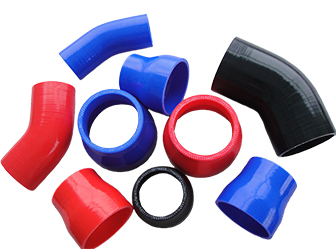
Universal silicone couplers — straight hose, reducers, 45-degree and 90-degree elbows, hump hose, and other standard shapes — provide flexible connection solutions across a range of diameters and installation geometries without requiring custom tooling.
Food grade silicone hose and silicone braided hose serve applications where material purity and pressure handling matter more than thermal extremes. Extruded silicone products, including vacuum line and industrial tubing, are typically unreinforced single-layer constructions suited to low-pressure or vacuum service at moderate temperatures. Molded silicone parts extend the material into three-dimensional components for industrial, healthcare, and consumer applications.
Rubber hose — including EPDM coolant hose, EPDM air intake hose, and nitrile rubber fuel hose — remains appropriate for standard-duty applications where cost is the primary consideration and operating conditions fall within conventional limits.
How Does a Silicone Hose Work — And Where Most Buyers Get It Wrong
The working principle of a silicone hose depends on the type of load it is designed to handle. Most reinforced automotive silicone hoses share a layered construction, but the way that construction responds to pressure, vacuum, temperature, and fluid exposure varies significantly depending on how it was engineered. Four assumptions commonly lead buyers toward the wrong product.
Assumption One: Temperature rating is the primary selection criterion
Silicone rubber owes its thermal stability to the silicon-oxygen (Si-O) backbone of its molecular structure. The Si-O bond has a higher bond energy than the carbon-carbon (C-C) bonds that form the backbone of most conventional rubbers. This gives silicone greater resistance to thermal degradation at elevated temperatures, and also maintains flexibility at low temperatures where many carbon-based elastomers become brittle.
However, the temperature rating of a finished hose depends on more than the silicone compound alone. Reinforcement fibers have their own thermal limits. Adhesion between layers can degrade before the silicone compound itself fails. And fluid compatibility at elevated temperature is a separate question entirely.
A silicone hose for coolant, for example, may use a compound rated for continuous service above 200°C, but if the coolant formulation is chemically incompatible with that compound, degradation will occur at normal operating temperatures. SUNRISE's OAT-resistant coolant hose addresses this directly — it is specifically compounded and tested for compatibility with Organic Acid Technology antifreeze under SAE J20 Class A conditions, using a 50/50 coolant-to-water mixture. Standard silicone coolant hose compounds may not offer the same resistance, which means selecting a silicone radiator hose based on temperature rating alone, without confirming coolant compatibility, can result in premature failure.
Assumption Two: A standard reinforced hose works for vacuum applications
Pressure and vacuum place structurally opposite demands on a hose. In a positive-pressure application — coolant circulation, turbocharging, charge air — the fluid or gas inside the hose exerts outward force on the walls. The reinforcement layer resists this outward expansion and maintains the hose's shape and diameter under load.
In a vacuum application, the situation reverses. Atmospheric pressure outside the hose exerts inward force. Without a structure designed to resist this inward load, the hose wall deflects inward, reducing the internal bore and restricting or blocking flow. A braided polyester reinforcement layer, which is effective at resisting outward expansion, provides little resistance to inward collapse.
Wire-reinforced silicone vacuum hose solves this by embedding a continuous steel spring in the hose wall. The helical wire provides radial stiffness that resists inward deformation regardless of the external pressure differential. This is why silicone hose vacuum applications require a specifically designed construction, not a standard reinforced hose selected for temperature rating alone.
Assumption Three: More reinforcement layers always mean better performance
Reinforcement improves pressure resistance and dimensional stability, but it also reduces flexibility. In applications with complex routing — tight bends, limited installation space, or connections that must absorb engine movement — excessive reinforcement can make a hose difficult to install and introduce stress concentrations at connection points.
The four main reinforcement materials used in automotive silicone hoses each offer a different balance of properties. Polyester fiber is the most commonly used and offers a practical combination of pressure resistance, flexibility, and cost. It performs well across the temperature range of most coolant, heater, and intake applications. Aramid fiber — including Kevlar — provides significantly higher tensile strength at lower wall thickness, making it appropriate for high-pressure applications where weight or space is a constraint. Glassfiber reinforcement extends useful thermal performance closer to heat sources and is often used in applications where the hose runs near exhaust components. Steel wire, as noted above, is the only reinforcement structure that reliably prevents collapse under vacuum pressure.
For most vehicle silicone hose applications — including silicone hose for coolant, silicone rad hose, and standard intake systems — single or double-layer polyester braiding is the appropriate choice. Specifying aramid or glassfiber reinforcement in a standard coolant application does not improve performance and adds unnecessary cost.
Assumption Four: Food grade and fuel cell hoses are simply upgraded versions of standard silicone hose
Food grade and fuel cell silicone hoses operate on a different principle from pressure hoses. Their primary function is not to withstand mechanical load but to transfer media without contaminating them.
Standard silicone hose is typically cured using a peroxide-based process. Peroxide curing can leave chemical residues in the finished hose that may leach into the fluid being transferred. For food contact applications, platinum-cured silicone is the appropriate choice. The platinum catalysis process produces a cleaner cure with significantly lower extractable residue levels, which is why platinum-cured silicone is the standard for food-grade and pharmaceutical tubing.
For fuel cell applications, the concern shifts to a specific class of compounds called cyclic siloxanes — volatile silicon-containing molecules that can migrate out of conventional silicone rubber under operating conditions. In a hydrogen fuel cell system, cyclic siloxanes that reach the membrane electrode assembly can adsorb onto the platinum catalyst, reducing its activity and degrading fuel cell performance over time. Silicone hose designed for fuel cell service uses specially formulated compounds with a low proportion of extractable cyclic siloxanes. Where additional chemical resistance is required — particularly in anode-side or fuel supply applications — an FKM inner lining provides a barrier between the silicone structure and the transported medium.
A Practical Selection Framework for B2B Buyers
Rather than working through a generic checklist, the most efficient approach is to match the application scenario directly to the construction requirements.
For coolant and radiator applications, confirm the coolant formulation before specifying the hose compound. OAT and HOAT coolants require a compound validated for that chemistry under SAE J20 conditions. Hose dimensions, bend geometry, and connection interface should be confirmed from a drawing or existing sample to ensure correct fitment.
For turbocharger, CAC, and high-pressure intake applications, temperature and working pressure are the primary parameters. Reinforcement layer count and construction should be selected to provide an adequate safety margin above maximum operating pressure. For complex bend geometries, a physical sample or 3D drawing significantly reduces development time.
For vacuum applications, wire reinforcement is the correct starting point. Wall thickness and internal diameter should be confirmed against the vacuum level and flow requirements of the system. Standard braided silicone hose should not be substituted.
For food grade, pharmaceutical, or fuel cell applications, specify platinum-cured compound for food contact and low-extractables compound for fuel cell service. Confirm whether an FKM lining is required based on the specific medium and circuit location.
For custom requirements — non-standard dimensions, complex shapes, specific color or marking, or integration of metal fittings — provide a drawing, sample, or dimensional sketch. SUNRISE supports custom silicone hose development from sample or drawing, with a minimum order quantity of 10 pieces per item for molded products.
Conclusion
A silicone hose works by matching its structural design to the specific demands of its operating environment. Temperature rating is one input into that equation, not the conclusion. The reinforcement structure, compound formulation, curing method, and lining — if any — each contribute to how the hose performs under actual service conditions.
SUNRISE has been manufacturing performance silicone hoses and molded silicone products since 2006 and holds IATF 16949 and ISO 9001 certification. The product range covers vehicle silicone hoses, special use constructions, food grade tubing, fuel cell hose solutions, and custom molded silicone components for automotive, industrial, railway, and other applications.
If you are sourcing silicone hoses for a specific application, the most efficient path to the right product is to share your operating conditions, fluid type, dimensions, and any applicable standards. Send your drawing, sample, or technical requirements to us and our team will evaluate the appropriate construction and provide a quotation based on your actual application.

Sunrise Silicone Hose Co., Limited


Address : Suite 805, No. 341 Jiahe Road, Xiamen City, Fujian Province, China
Email : sales@siliconehose-china.com