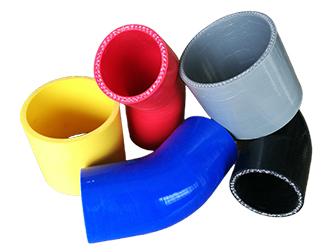
When buyers compare quotes from two suppliers for silicone hoses that look identical on paper, a 30% price gap is not unusual. The difference rarely comes from the base material alone. It can result from manufacturing discipline, including compounding formulas, curing cycles, cleaning procedures, and inspection protocols. Each step can affect the hose's long-term performance.
This article follows the production journey of a silicone hose at SUNRISE, from raw material preparation to final inspection and shipment, helping B2B buyers understand what happens behind the specifications.
Why the Compound Choice Happens Before
Any Machine Starts
Performance starts with the compound.
Standard high-temperature silicone is suitable for many automotive applications. When buyers search for products using terms such as silicone hose car or silicone hose turbo, they may be referring to different hose constructions designed for specific vehicle systems.
For fuel cell applications, low-extractables formulas are used to reduce the risk of cyclic siloxanes affecting proton exchange membranes. Platinum-cured, FDA-compliant compounds are used for food-grade tubing where low chemical residue is required. For anode-side or fuel-supply circuits, FKM/Viton-lined constructions can provide improved resistance to oils and fuels.
During rubber compounding, raw silicone is repeatedly mixed until the material becomes homogeneous. Additives such as flame retardants, pigments, and reinforcing fillers can be introduced at this stage. The quality of compounding affects the final hardness, elasticity, and temperature resistance of the hose.
This is an important control point in silicone hose manufacturing and is supported by documented manufacturing procedures under IATF 16949.
The compounded material is then calendered into uniform sheets. Consistent sheet thickness is important for maintaining wall uniformity and pressure distribution in the finished hose. The sheets are then precisely cut to size, with cutting accuracy affecting seam quality during mandrel wrapping.
These early steps establish the foundation for reliable silicone hoses.
The Mandrel Is the Mold — Why Custom Shapes Require Custom Tooling
Forming is where the hose geometry is defined.
Cut sheets are wrapped around a metal mandrel to create a tubular structure. The mandrel's shape determines the inner diameter, bend angles, and overall geometry of the finished hose.
Straight hoses can use standard mandrels, while complex shapes such as 90-degree elbows, S-bends, and CAC hoses may require custom mandrels. This is why drawings or samples are important for custom projects: the appropriate mandrel needs to be prepared before production begins.
Reinforcement layers are added during wrapping, alternating with silicone layers. Polyester braiding is commonly used in applications such as silicone hose intake,
silicone hose turbo, and silicone hose intercooler products, helping balance pressure resistance and flexibility.
Steel spiral wire can be used for vacuum hoses, providing radial stiffness and helping prevent collapse under negative pressure. Aramid reinforcement, such as Kevlar, can provide higher burst strength with reduced wall thickness for high-pressure applications. Glass fiber reinforcement can extend thermal performance for hoses used closer to heat sources.
Once wrapped, the assembly is placed into a mold and tightly bound with glassine paper. During curing, the paper applies uniform external pressure, helping keep the hose in close contact with the mold cavity. This contributes to dimensional accuracy and surface quality.
One Cure Is Not Enough — Why Two-Stage Vulcanization Defines Product Quality
Vulcanization is one of the most technically important stages of silicone hose production.
Primary vulcanization takes place in a high-temperature oven. At the molecular level, silicon-oxygen (Si-O) bonds undergo crosslinking, transforming linear chains into a three-dimensional network that provides elasticity and strength. Industry practice typically uses temperatures in the range of 150 to 200°C for primary vulcanization, establishing the hose's basic shape and initial mechanical properties.
After demolding, hoses undergo a two-step cleaning process. Isopropyl alcohol can dissolve mold-release agents and organic residues, while deionized water removes ionic contaminants.
For fuel cell-grade hoses, this cleaning process can affect coolant conductivity. For food-grade products, it helps ensure that chemical residues are removed from surfaces that may contact consumables.
Post-curing follows at higher temperatures for several hours. This step reduces volatile low-molecular-weight substances, including cyclic siloxanes, and can further improve temperature resistance, compression-set performance, and long-term dimensional stability.
Primary curing establishes the basic crosslinked structure, while post-curing further reduces residual small molecules and improves long-term stability. Together, these stages play an important role in the final performance of silicone hoses.
Quality Does Not Start at the End — It Is Built Into Every Step
Quality inspection begins with the hose itself.
Leak testing is performed on every hose. Products are pressurized and either submerged for bubble detection or tested with dedicated instrumentation. This provides a direct check of structural integrity.
Initial inspection covers surface defects, color uniformity, inner-wall quality, and wall thickness. Non-uniform walls can create weak points under pressure. Hoses are then trimmed to the specified length.
For proper
silicone hose clamp installation, the flatness and condition of the hose end are important. A properly prepared connection helps the clamp achieve reliable sealing without damaging the hose.
Clamp-mark printing adds installation reference lines to the hose surface. These marks help indicate the correct position for a silicone hose clamp, keeping the clamp within the designated area to achieve proper sealing while avoiding excessive compression.
SUNRISE also provides laser-etched batch numbers for product traceability.
From Hose to Assembly — The Final Steps Before Shipping
Protective sleeves can be installed where specified to provide thermal or abrasion resistance in demanding engine-bay environments.
Clamps and fittings are assembled according to the hose's outer diameter and working pressure. After crimping or assembly, finished products can undergo a final pressure-hold test as the last quality check before shipment.
Every unit is individually inspected rather than relying only on sampling. Laser marking allows each product to be traced back to its production batch.
Products are then labeled, bagged, and prepared for dispatch. Shipping options include FedEx, DHL, TNT, UPS, ARAMEX, sea freight, air freight, and rail.
For automotive applications, these final checks help ensure that a finished silicone hose arrives ready for installation and meets the specified requirements.
What the Manufacturing Process Tells You About Supplier Quality
The production process can reveal important differences between suppliers.
Two-step cleaning versus single-step cleaning can be significant for fuel cell and food-grade applications. Two-stage vulcanization versus single curing can affect long-term stability and extractable levels. Leak-test frequency also matters: 100% inspection provides a different level of process control from spot checking.
Laser batch marking provides another indication of traceability and production control.
SUNRISE holds IATF 16949 certification, with documented procedures and records supporting its manufacturing control points. When evaluating silicone hose suppliers, buyers should look beyond material grades and also ask about compounding controls, curing cycles, cleaning procedures, and inspection frequency.
Conclusion
The quality of a silicone hose is determined by the entire production chain, from compound selection and material preparation to forming, vulcanization, cleaning, inspection, and traceability.
Products with similar specifications can perform differently when manufacturing processes and quality controls differ.
SUNRISE has focused on silicone hose manufacturing since 2006 and holds IATF 16949 and ISO 9001 certifications. Every stage from raw material preparation to shipment is supported by quality records.
If you are evaluating a custom hose project, sharing your operating conditions, fluid type, dimensions, applicable standards, and a drawing or sample can help determine the appropriate hose construction. SUNRISE can then assess the requirements and provide a quotation based on the application.
FAQ
Will silicone hose hold up to gasoline?
Standard silicone has limited resistance to non-polar hydrocarbon solvents such as gasoline. Aromatic components such as benzene, toluene, and xylene can penetrate the silicone matrix, causing swelling and reduced mechanical properties.
FKM (fluoroelastomer) linings can provide an effective chemical barrier and improved resistance to hydrocarbon permeation. This is why FKM-lined hoses are used for applications involving fuel and oil contact.
SUNRISE offers Viton-lined silicone hoses with temperature ratings up to 250°C for such applications.
How to bend silicone hose?
Silicone's high flexibility makes it easier to bend than EPDM and some conventional rubbers. However, every hose has a minimum bend radius. Excessive bending can cause the inner wall to fold, reducing the effective bore and increasing flow resistance.
For fixed bend angles, custom-molded elbows are generally more appropriate than forcing a straight hose into shape.
During installation, slight bending at the connection may be acceptable, but the silicone hose clamp should be positioned on the straight section near the hose end to help ensure proper sealing.
What are the benefits of using silicone hoses in automotive applications?
From a manufacturing perspective, post-curing can improve long-term stability and compression-set performance, helping maintain elastic sealing over time.
Reinforcement design also provides flexibility in hose construction. Different reinforcement layers can be selected to meet different pressure requirements.
The Si-O bond structure allows silicone hoses to maintain performance a
cross a wide temperature range. Some of SUNRISE's reinforced vehicle hose constructions are rated for approximately -54°C to +260°C, depending on the specific product and application.
Mandrel forming also allows manufacturers to produce complex hose geometries for automotive applications, including products commonly searched as silicone hose car, silicone hose turbo, silicone hose intercooler, and silicone hose intake.