When selecting a reinforced silicone hose for automotive or industrial applications, reinforcement structure is an important factor affecting pressure handling, flexibility, and long-term performance. Among the available options, 1-ply and 2-ply reinforced silicone hoses are two common constructions used in high-temperature fluid and air transfer systems.
Although both designs use polyester textile reinforcement embedded within the silicone rubber wall, they differ in the number of braided layers and their structural characteristics. For engineers, OEM buyers, and equipment manufacturers, understanding these differences helps determine which hose construction is more suitable for specific operating conditions.
SUNRISE Silicone Hose Co., Limited offers both single-ply and double-ply reinforced silicone heater hoses, with customized dimensions and colors available for different application requirements. This guide compares their structures, performance characteristics, and selection considerations.
A reinforced silicone hose consists of an inner silicone rubber tube, a textile reinforcement layer, and an outer silicone rubber cover. The silicone material provides flexibility, temperature resistance, and environmental durability, while the reinforcement helps control hose expansion under internal pressure.
Polyester braiding is commonly used in reinforced silicone hoses because it offers a practical balance between mechanical strength, flexibility, and manufacturing cost. The braided textile is integrated into the hose wall during production rather than simply wrapped around the outside.
Depending on the application, manufacturers can adjust the number of reinforcement layers, hose wall thickness, inner diameter, and silicone compound to achieve the required construction.
The main difference between 1-ply and 2-ply reinforced silicone hoses is the number of polyester braided reinforcement layers incorporated into the silicone wall. This structural difference affects how the hose responds to pressure and mechanical stress.
A 1-ply reinforced silicone hose contains one layer of open-mesh polyester braiding embedded within the silicone rubber wall. This construction provides additional structural support while maintaining the flexibility needed for automotive hose routing and installation.
Single-ply reinforcement is commonly selected for coolant circulation, heater connections, air intake connections, and other applications where temperature resistance and flexible installation are important.
SUNRISE's 1Ply Reinforced Silicone Heater Hose is designed with single polyester braid reinforcement. The product is listed as meeting the performance and physical criteria of SAE J20 R3 and offers a recommended working temperature range of -60°C to +200°C.
For applications requiring a flexible reinforced hose without an additional braid layer, buyers can explore the single-ply silicone heater hose product details.
A 2-ply reinforced silicone hose incorporates two layers of polyester braided reinforcement within the silicone rubber wall. The additional braid layer provides more textile reinforcement and is intended for applications requiring greater structural support and pressure resistance.
Compared with a single-ply construction, the double-ply design offers an additional reinforcement layer to help restrain expansion under internal pressure. However, the actual improvement depends on braid specifications, hose dimensions, wall thickness, and manufacturing quality.
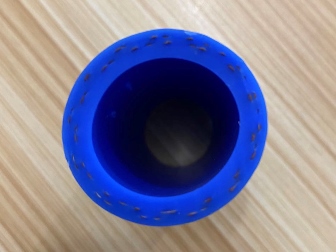
Cross-sectional view showing the reinforced structure of a double-ply silicone hose.
SUNRISE's 2Ply Reinforced Silicone Heater Coolant Hose uses double-layer polyester reinforcement and is designed for automotive heater and coolant applications. Its listed continuous working temperature range is -54°C to +200°C.
For buyers who need additional reinforcement in their hose construction, the 2-ply reinforced silicone heater coolant hose provides a product-specific option for evaluation.
Both constructions offer the advantages of silicone rubber, including flexibility, resistance to ozone and UV exposure, and suitability for elevated-temperature environments. Their reinforcement configurations create different mechanical characteristics.
| Comparison Factor | 1-Ply Silicone Hose | 2-Ply Silicone Hose |
|---|---|---|
| Reinforcement layers | One polyester braid layer | Two polyester braid layers |
| Structural support | Single-layer textile reinforcement | Additional textile reinforcement |
| Pressure handling | Suitable for specified pressure requirements | Designed for applications requiring additional reinforcement |
| Flexibility | Generally offers a flexible construction | May have a different bending response depending on design |
| Typical applications | Heater connections, coolant lines, air transfer | Heater and coolant systems requiring additional reinforcement |
| Selection priority | Flexibility and specified operating conditions | Additional structural support and verified pressure requirements |
It is important to understand that two reinforcement layers do not automatically provide twice the working pressure of a single-layer hose. Pressure performance must be confirmed through product-specific testing, including working pressure, burst pressure, and temperature-related performance.
When fluid or compressed air flows through a silicone hose, internal pressure creates forces that act against the hose wall. Polyester braiding helps restrain radial expansion and maintain the hose's dimensional stability.
A second reinforcement layer introduces additional textile support. This can be beneficial in applications where pressure fluctuations or mechanical demands require a more reinforced construction. However, hose diameter, braid angle, yarn strength, and wall thickness must also be considered when determining the actual pressure rating.
Flexibility is another important consideration when choosing between single-ply and double-ply silicone hoses. Automotive engine compartments and industrial equipment often have limited installation space, making bending radius and connection geometry important.
A 1-ply hose may be suitable where flexible routing is a priority. A 2-ply hose provides additional reinforcement, but its bending behavior should be evaluated against the required installation radius.
For systems requiring customized routing, buyers may also consider reinforced straight silicone hose couplers, which are available with customized dimensions and multi-layer polyester reinforcement.
Both 1-ply and 2-ply constructions retain the basic thermal and environmental properties of their silicone rubber compounds. Polyester reinforcement primarily contributes mechanical support rather than independently determining the hose's temperature resistance.
SUNRISE's reinforced silicone heater hose products are designed for elevated-temperature applications. The listed temperature ranges of the two products are similar, although their individual specifications should be checked before final selection.
For applications exposed to engine heat, ozone, UV radiation, and moisture, the complete hose construction should be evaluated rather than selecting a product based only on its reinforcement layer count.
Reinforced silicone hoses are used across automotive, commercial vehicle, marine, and industrial equipment systems. The appropriate construction depends on the pressure, temperature, fluid, and installation requirements of each application.
Automotive heater hoses and coolant hoses transfer hot coolant between the engine, radiator, and heater core. These systems require materials that can withstand elevated temperatures and repeated thermal cycles.
Both single-ply and double-ply reinforced silicone hoses can be considered for heater and coolant applications, provided that the selected product meets the system's pressure and temperature requirements.
Trucks, buses, agricultural machinery, and off-highway vehicles often operate under demanding environmental conditions. Their cooling and heating systems may experience continuous vibration, temperature fluctuations, and long operating hours.
In these applications, reinforcement structure, hose routing, connection security, and service life should all be considered during product selection.
Industrial equipment may use reinforced silicone hoses for transferring liquids or air in systems where flexibility and temperature resistance are important. The required reinforcement level depends on the operating pressure and the nature of the transferred medium.
For other specialized requirements, SUNRISE also provides different silicone hose products and reinforcement constructions, including polyester, aramid, fiberglass, and wire-reinforced options.
Choosing between 1-ply and 2-ply reinforced silicone hoses should start with the actual operating conditions rather than the assumption that more reinforcement is always better.
Before requesting a quotation or selecting a hose, purchasing teams and engineers should confirm the following information:
For customized projects, providing technical drawings, existing hose samples, or detailed operating parameters can help the manufacturer recommend a suitable reinforcement construction.
SUNRISE supports customized silicone hose manufacturing with different dimensions, colors, and reinforcement configurations. Buyers can submit their application requirements through the custom silicone hose service to discuss product specifications.
SUNRISE Silicone Hose Co., Limited specializes in silicone hose manufacturing for automotive and industrial applications. Its product range includes single-ply and double-ply polyester braided hoses, silicone heater hoses, coolant hoses, turbocharger hoses, and other customized silicone products.
With different reinforcement options and product configurations, SUNRISE can support buyers who need silicone hoses designed around specific dimensions and operating conditions.
Whether your project requires a flexible single-ply construction or a double-ply hose with additional textile reinforcement, selecting the right structure begins with understanding the actual service environment.
Contact SUNRISE to discuss your silicone hose requirements, including inner diameter, wall thickness, working pressure, temperature range, reinforcement structure, and customization needs.
The main difference is the number of polyester reinforcement layers embedded in the silicone wall. A 1-ply hose has one braided layer, while a 2-ply hose has two. The additional layer provides more textile reinforcement, but actual pressure performance depends on the complete hose construction.
A 2-ply silicone hose has an additional reinforcement layer and is designed to provide greater structural support. However, it does not automatically have twice the working pressure. Product-specific pressure and burst testing should be used for comparison.
Both constructions can be manufactured for elevated-temperature applications. SUNRISE lists a recommended working temperature range of -60°C to +200°C for its 1-ply heater hose and a continuous working temperature range of -54°C to +200°C for its 2-ply heater coolant hose. Always confirm the specific product rating before use.
Both 1-ply and 2-ply reinforced silicone hoses can be used in suitable automotive coolant systems. The choice depends on system pressure, temperature, installation space, and the required product specifications.
Yes. SUNRISE offers customized reinforced silicone hoses with different inner diameters, colors, and reinforcement configurations. Buyers can provide drawings, samples, or application specifications for evaluation.
Additional reinforcement can improve resistance to pressure-driven expansion. However, working pressure is also affected by hose diameter, wall thickness, braid material, construction quality, and operating temperature. Testing is necessary to establish the actual rating.

Sunrise Silicone Hose Co., Limited


Address : Suite 805, No. 341 Jiahe Road, Xiamen City, Fujian Province, China
Email : sales@siliconehose-china.com